
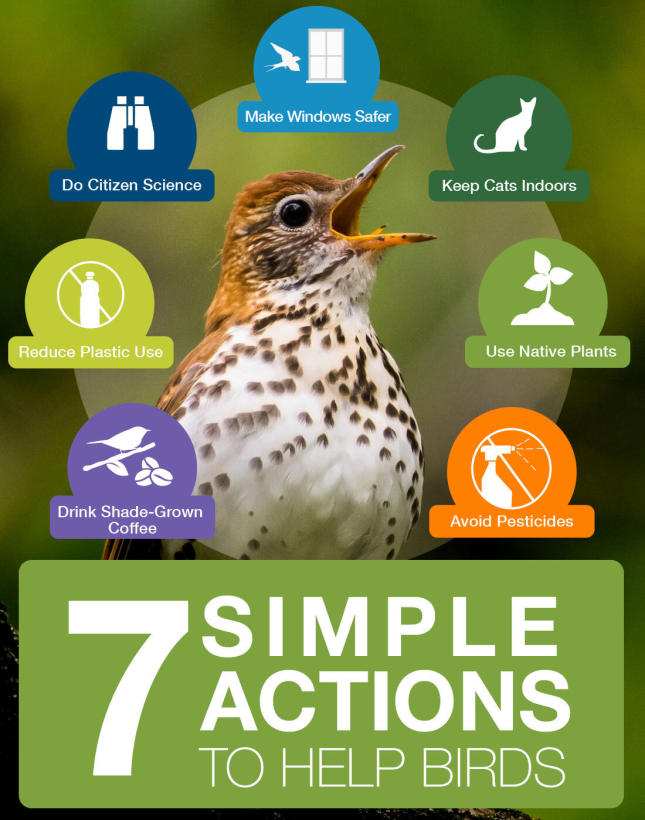
7 Simple Actions to Help Birds
A study* published September 2019 in the journal Science, found that the population of breeding birds in the US and Canada has dropped by nearly 30% (or 3 billion birds) since 1970.
- Make Windows Safer, Day and Night.
- By day, birds perceive reflections in glass as habitat they can fly into. By night, migratory birds drawn in by city lights are at high risk of colliding with buildings.
- On the outside of the window, install screens or break up reflections—using film, paint, or other markers spaced no more than 2 inches high or 4 inches wide. Learn more about Why Birds Hit Windows—and How You Can Help Prevent It.
- Keep Cats Indoors.
- Cats instinctively hunt and kill birds –an estimated at more than 2.6 billion birds annually in the U.S. and Canada– even when well fed. This is the #1 human-caused reason for the loss of birds, aside from habitat loss.
- Save birds and keep cats healthy by keeping cats indoors or creating an outdoor “catio.” Provide your cat hours of entertainment by setting up a bird feeding station outside with a comfortable indoor viewing area. You can also train your cat to walk on a leash. Learn more from the American Bird Conservancy.
- Reduce Lawn, Plant Natives.
- Birds have fewer places to safely rest during migration and to raise their young: More than 10 million acres of land in the United States were converted to developed land from 1982 to 1997. Adding native plants to your yard not only adds interest and beauty to your yard and neighborhood, they provide shelter and nesting areas for birds. The nectar, seeds, berries, and insects will sustain birds and diverse wildlife.
- Visit the National Audubon Society and National Wildlife Federation to find out which native plants are best for birds in your area.
- Avoid Pesticides.
- More than 1 billion pounds of pesticides are applied in the United States each year. The continent’s most widely used insecticides, called neonicotinoids or “neonics,” are lethal to birds and to the insects that birds consume. Common weed killers used around homes, such as 2, 4-D and glyphosate (used in Roundup), can be toxic to wildlife, and glyphosate has been declared a probable human carcinogen.
- In addiiton to reducing pesticides around your home and garden, consider purchasing organic food. The Environmental Working Group's Dirty Dozen™ and Clean Fifteen™ lists –highlighting produce with the highest and lowest pesticide residues– help shoppers prioritize which fruits and vegetables to buy organic.
- Drink Shade-Grown Coffee.
- Three-quarters of the world’s coffee farms grow their plants in the sun, destroying forests that birds and other wildlife need for food and shelter. Sun-grown coffee also often requires using environmentally harmful pesticides and fertilizers. On the other hand, shade-grown coffee preserves a forest canopy that helps migratory birds survive the winter.
- Shade-grown coffee is delicious, economically beneficial to coffee farmers, and helps more than 42 species of North American migratory songbirds that winter in coffee plantations, including orioles, warblers, and thrushes. Look for Bird-Friendly coffee, a certification from the Smithsonian Migratory Bird Center that also includes organic and fair trade standards.
- Use Less Plastic.
- Plastic takes more than 400 years to degrade, and 91% of plastics created are not recycled. Studies show that at least 80 seabird species and other wildlife ingest plastic, mistaking it for food, or become entangled in it.
- Avoid single-use plastics including bags, bottles, wraps, and disposable utensils. If you do have disposable plastic, be sure to recycle it. Learn how and where to recycle these products.
- Watch Birds and Share What You See (Citizen Science).
- Monitoring birds is essential to help protect them, but tracking the health of the world’s 10,000 bird species is an immense challenge. To understand how birds are faring, scientists need hundreds of thousands of people to report what they’re seeing in backyards, neighborhoods, and wild places around the world. Without this information, scientists will not have enough timely data to show where and when birds are declining around the world.
- Join a project such as eBird, Project FeederWatch, a Christmas Bird Count, or a Breeding Bird Survey to record your bird observations. Your contributions will provide valuable information to show where birds are thriving—and where they need our help.
To learn more, visit 3BillionBirds.org's 7 Simple Actions and more that you can do to help birds.
We encourage you to spread the word about how we can all help. Be sure to share this information and use the hashtag #SaveTheSongBirds.
*The study is a collaboration between avian and conservation scientists, led by Ken Rosenberg from the Cornell Lab of Ornithology and American Bird Conservancy.